

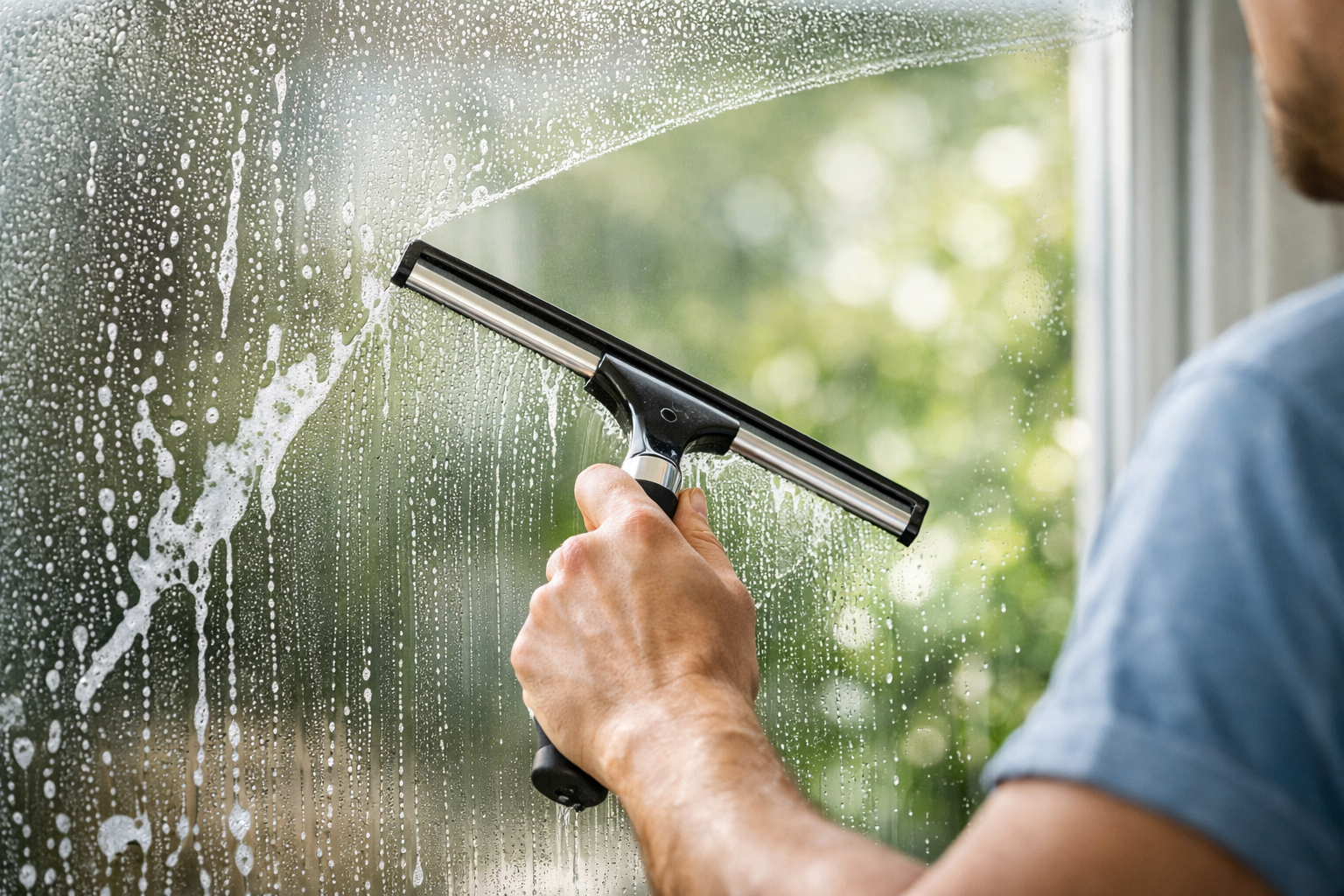
How to clean glass properly from the start
Getting off to a good start makes almost all the difference between clean glass and a finish full of streaks. Before you even think about the product, it is worth preparing the surface, choosing the right tools and avoiding basic mistakes, such as cleaning in direct sunlight. The ideal is to clean on overcast days or at times when the sun is not too strong, so that the water and cleaning solution do not dry too quickly. This helps you achieve a spot-free, streak-free result from the very first pass.
Materials you need to clean glass without scratching it
To clean glass in the simplest and most effective way, you do not need lots of products, just the right ones. Have a bucket of warm water, mild detergent, a soft sponge, a microfibre cloth and, if the area is larger, a window squeegee. Microfibre is one of the best choices because it cleans well, does not scratch and helps with drying without leaving lint behind.
On exterior glass or larger windows, a squeegee can speed up the process considerably, as long as the rubber blade is in good condition. The sponge should always be soft, so it loosens dirt without damaging the glass. It also helps to keep one cloth just for the glass and another for the frames, to avoid spreading dirt from one area to another.
What to do before applying any product to the glass
Before spraying or applying any mixture, look at the condition of the glass and the frame. Very often, the problem is not the product but the build-up of dust, sand or residue. If you apply liquid directly over that dirt, you will create a dirty film that is harder to remove and increase the chance of leaving streaks.
Another important point is to check the conditions at the time. If you want to clean glass without leaving streaks, this step is essential: avoid cleaning in direct sunlight, because the product dries too quickly and affects the finish. If possible, choose overcast days and work on one window at a time, especially when cleaning exterior glass.
Why you should clean from top to bottom
Cleaning from top to bottom is not just a matter of method. It prevents dirt from running down onto areas you have already cleaned. By starting at the top, you have better control over the water, detergent and residue, and you can clean more evenly.
This direction also makes it easier to use a squeegee, because it lets you pull moisture downwards in one continuous motion. At the end, less water is left around the edges and drying becomes faster. It is a simple detail, but a decisive one if you want the glass to look more even and genuinely streak-free.
How to remove dust and residue before washing
Removing dust first should always be the first step. Wipe the glass with a dry microfibre cloth or a slightly damp cloth, paying attention to the corners, seals and frames. If there is heavier build-up, you can use a very soft brush to loosen the residue before the main wash.
Only after this preparation does it make sense to move on to a mixture of water and mild detergent applied with a soft sponge. This sequence reduces friction from dirt on the glass, improves the final result and makes drying much more effective. Instead of spreading dust and creating marks, you clean the surface with more control and end up with a visibly cleaner finish.
How to clean glass without leaving streaks
After removing the dust and preparing the surface properly, the aim is simple: wash and dry at the right moment so the glass is left spotless and streak-free. This is where many people go wrong. They either use too much product, let the water dry on its own or clean in direct sunlight, which speeds up evaporation and increases streaking. For the best result, keep the method simple, work from top to bottom and clean on overcast days or when the glass is not warm.
The best homemade solution for cleaning glass
In most situations, there is no need for complicated formulas. To clean glass without leaving streaks, a mixture of warm water with a few drops of mild detergent is usually enough to clean well without leaving too much residue. Apply the solution with a soft sponge or a slightly damp microfibre cloth, without soaking the glass.
The secret is the amount. If you use too much detergent, it creates a film that is hard to remove; if you use too little, grease and fingerprints may remain visible. The mixture should simply help loosen the dirt, not build up on the glass. On larger surfaces, you can spread the solution in sections, always using controlled movements so the product does not start drying too soon.
How to dry glass without creating marks
The step that really determines whether glass is left spotless is almost never the washing, but the drying. After cleaning, the glass should not be left to air-dry, because the droplets leave visible residue, especially when the water contains minerals or there is too much product. Ideally, it should be dried straight away, before moisture settles back onto the surface.
If you are cleaning a large window, a squeegee is one of the most effective ways to remove excess water. Run it from top to bottom in continuous movements, wiping the blade between passes so you do not spread dirt back over the surface. On the edges, corners and areas the squeegee cannot reach properly, finish with a dry microfibre cloth. Microfibre helps absorb the remaining moisture without shedding lint and greatly improves the final finish.
On smaller panes, or when cleaning mirrors as well, you can do all the drying with microfibre alone, as long as you use a clean, dry cloth. The most important thing is not to rub in a rush or leave damp patches until the end. Immediate, complete drying is what turns an ordinary clean into a visibly more even, brighter and streak-free result.
How to clean window glass inside and outside
Once you move from theory to practice, the difference between cleaning glass on the inside and outside becomes obvious. Indoors, the dirt is usually lighter and linked to dust, fingerprints and a little grease. Exterior glass, on the other hand, has more residue brought by rain, wind, pollution and particles collected around the frames. So although the basic method is the same, it is worth adapting your approach to each side of the window if you want a spot-free, streak-free finish.
How to clean window glass on the inside
To clean window glass indoors, start by removing the dust with a dry or slightly damp microfibre cloth, without forgetting the corners and frames. Only then apply the water and mild detergent solution using a soft sponge or a clean cloth. Do not soak the glass: too much product usually means more work when drying and a greater risk of streaks.
Clean from top to bottom, working in sections. This helps you control moisture better and stops dirt from running down onto areas you have already cleaned. At the end, remove the excess with a squeegee or a dry microfibre cloth, paying extra attention to the edges, where water tends to collect. This sequence is simple, quick and works well on most glass surfaces and windows inside the home.
How to clean the outside of windows safely
When it comes to cleaning exterior glass, the result depends as much on technique as on safety. If access is easy, start by removing excess dust and loose residue, especially around the edges and near the frames. Then wash with water, mild detergent and a soft sponge, always without pressing too hard. Because exterior glass collects more dirt, you may need to repeat the process before drying.
Whenever possible, choose overcast days and avoid working in direct sunlight, because the glass heats up, the water evaporates more quickly and you are more likely to end up with a finish that looks fine at first glance but reveals marks when the light changes. If the window is high up, difficult to reach or unsafe, it is not worth risking awkward leaning or improvised supports. In these cases, the right method also means knowing when a window cannot be accessed safely.
When to use an extension pole or specialist brush
When exterior glass is harder to reach, an extension pole or a specialist glass-cleaning brush can help you reach higher areas without forcing unsafe positions. These tools are useful for large windows, enclosed balconies and some roof windows, as long as they allow you to work steadily and with control.
Even so, the principle remains the same: remove dust first, wash with a mild solution, work from top to bottom and make sure the surface is dried properly. The right tool makes reaching the glass easier, but it does not replace the method. Whenever the tool makes it harder to achieve a careful finish or leaves excess water around the edges, it is worth finishing accessible areas with microfibre or a squeegee to ensure a genuinely clean result.
How to clean very dirty glass
When dirt has been building up for weeks or months, cleaning requires more method and less haste. When cleaning very dirty glass, the most common mistake is trying to solve everything in one pass. That usually spreads the dirt, scratches the surface with dust particles and leaves the glass looking dull even after washing. In these cases, the best approach is to loosen the residue first, clean in stages and make sure the glass is dried well at the end to get a spotless, streak-free finish.
How to loosen grease, fingerprints and built-up dirt
The first step is to remove excess dust and loose residue with a dry or slightly damp microfibre cloth. If you skip this stage, the dirt mixes with the water and creates a film that is hard to control. After this initial clean, apply a simple solution of warm water and mild detergent, using a soft sponge to soften the dirt without damaging the glass.
On areas with grease, old fingerprints or more stubborn marks, do not scrub hard straight away. The most effective approach is to dampen the surface well and keep working with gentle movements until the layer starts to lift. In kitchens, enclosed balconies or windows close to the street, this step makes a big difference, because the dirt is often stuck on in several thin layers rather than only sitting on the surface.
How long to leave the product to work
On genuinely dirty glass, leaving the solution on for a short time helps reduce the effort needed. It does not need long: usually a few minutes are enough for the mild detergent to start loosening built-up residue. The aim is not to let the product dry on the glass, but to give it time to soften the dirt before you go over it again with the soft sponge or cloth.
For that reason, avoid doing this in direct sunlight. The ideal is to clean on overcast days or when the glass is in the shade, so the mixture does not dry too soon. If the product evaporates quickly, the risk of streaks increases and you may have to repeat the job.
How to clean corners, seals and frames
In many cases, the glass still looks dirty because the corners, seals and frames hold onto residue that gets spread again during cleaning. That is why these areas should be treated carefully before the final stage. Run a microfibre cloth or a soft brush over the edges to remove dust, soil and debris trapped around the borders.
Only then should you move on to the glass itself, always from top to bottom. At the end, use the squeegee to remove excess water and finish the edges with dry microfibre. This sequence helps a great deal, especially on exterior glass, where the corners often collect more dirt and runoff.
Mistakes that make dirt worse instead of removing it
When glass is very dirty, some actions that seem harmless actually make the result worse. One is using too much product, because that creates more residue to remove and makes drying harder. Another is using dirty cloths or cloths that shed lint, which ruins a streak-free finish.
It is also a mistake to scrub hard from the start without first removing the dust or letting the solution work. That can spread the dirt, leave fine scratches and make the cleaning process more time-consuming. To clean very dirty glass with good results, the secret is to respect the order: remove residue, wash gently, dry thoroughly and only repeat where it is truly necessary.
How to clean glass and mirrors without marks
Although the basic method is similar, cleaning glass and mirrors in exactly the same way does not always give the best result. Both require control over the amount of product, dust removed beforehand and good drying, but mirrors tend to show fingerprints, lint and excess moisture more easily. To get a spotless, streak-free finish, it is worth adjusting small details and working more precisely, especially in areas where the light falls more directly.
Differences between cleaning glass and cleaning mirrors
In practice, glass and windows usually collect more environmental residue, especially exterior glass, while mirrors pick up more marks from daily use, such as splashes, steam and fingerprints. That is why glass often needs a more complete wash with water, mild detergent, a soft sponge and even a squeegee. With mirrors, what matters most is avoiding too much liquid, because the product can run into the edges and leave marks that are difficult to even out.
Another difference is how visible the dirt becomes. On a mirror, any failure in drying shows up immediately, especially in bathrooms or bright bedrooms. That is why the method needs to be more controlled: a small amount of solution, a clean cloth and consistent movements. The basic principle stays the same — clean from top to bottom, without rushing and without soaking the surface — but the finish requires more care.
How to avoid lint, streaks and fogging
If you want to clean glass and mirrors well, there are three problems to avoid: lint, streaks and fogging. The first usually comes from unsuitable cloths. The second appears when there is too much product or the surface is not dried properly. The third is common on bathroom mirrors, where moisture settles quickly again after cleaning.
To reduce these problems, always start by removing the dust with a dry microfibre cloth. Then, if needed, apply a small amount of water with mild detergent to a cloth or soft sponge, rather than wetting the surface directly. This gives you better control over moisture and avoids drips. It also makes a difference to clean at times without direct sunlight — in other words, on overcast days in the case of windows — because heat speeds up evaporation and encourages streaking.
With fogged mirrors, the main rule is still the same: keep moisture to a minimum and dry the surface completely straight after cleaning. Whenever the mirror is left partially damp, the surface loses its even finish and every mark becomes more visible.
The best cloth for a shiny finish
For a clean, subtle result, your best ally is usually a clean, dry microfibre cloth. Microfibre absorbs well, leaves behind less residue than many other fabrics and helps polish the surface without damaging it. On glass, it can be used on its own in the final stage or alongside a squeegee on larger areas. On mirrors, it is often enough for almost the whole process, as long as it is not too damp.
The best products and tools for cleaning glass
Choosing good tools makes the whole process easier and avoids two very common problems: spreading dirt instead of removing it and ruining the final drying stage. If you want to understand how to clean glass without leaving streaks, it is not enough to have “a glass cleaner”. The result depends on the combination of cleaning solution, the right cloth and the way it is applied. In many cases, less product and better tools give you a cleaner, quicker and genuinely spot-free finish.
Glass cleaner vs mild detergent
Between a dedicated glass cleaner and mild detergent, the best choice depends on the type of dirt and how often you clean. For regular maintenance, mild detergent diluted in water is usually enough. It is simple, versatile and helps clean without leaving as much residue when the amount is well controlled. On windows with light dirt, fingerprints or everyday marks, this solution usually works very well on both glass and mirrors.
A specific glass cleaner can be useful when speed matters or when there are larger surfaces to deal with. Even so, it does not work miracles on its own. If it is used in excess, it can still leave a film and make drying more difficult. So the real advantage is not only in the product itself, but in using it sparingly, after removing the dust and away from direct sunlight. On overcast days, either option tends to give a better result, because the glass does not dry too quickly.
Microfibre cloths, soft sponges and chamois
Microfibre cloths are among the most practical tools for anyone who wants to clean glass and mirrors with an even finish. Microfibre helps pick up fine dirt, usually leaves less lint behind and is especially useful in the final stage, when the goal is to leave the surface streak-free. For it to work well, the cloth should be clean and kept for this kind of task only, without residue from other cleaning jobs.
The soft sponge comes earlier, in the washing stage. It is ideal for spreading the mixture of water and mild detergent and loosening grease, fingerprints and other marks without scratching. A chamois may appeal to anyone who prefers a more polished finish, but it requires more care: if it is too damp or not properly clean, it can drag residue across the surface and spoil the result. In practice, for home use, the most balanced combination is usually simple: a sponge for washing and microfibre for finishing.
Window squeegee: when it helps and when it gets in the way
A window squeegee can be a great ally, especially on larger windows and exterior glass, where there is more area to dry and a greater risk of marks caused by water evaporation. When used correctly, it speeds up cleaning and greatly improves drying because it removes excess liquid evenly. The ideal is to run it from top to bottom, cleaning the rubber blade between movements so you do not spread dirt back across the surface.
The problem is that a squeegee can also get in the way if it is worn out, dirty or used badly. A dried-out blade leaves lines; disorganised movements create gaps; and poorly finished corners allow water to build up around the frames. On small panes, mirrors or surfaces with lots of cut-outs, a well-used microfibre cloth sometimes gives you more control and a better finish. In other words, a squeegee does not replace technique: it helps when the surface and the condition of the tool justify it, but it loses effectiveness when used without attention to detail.
Common mistakes when cleaning glass
Very often, the problem is not a lack of effort, but small mistakes in method that ruin the final finish. People looking for how to clean glass without leaving streaks usually focus on the product, when in practice the result depends above all on when you clean, how much you use and how the glass is dried. Even with mild detergent, water, microfibre and a squeegee, some habits make it much harder to leave glass spotless and streak-free.
Cleaning in direct sunlight
One of the most common mistakes is cleaning glass in direct sunlight. When the glass is warm, the water and product evaporate too quickly, which means the surface dries before the solution has been spread and worked properly. The result is usually glass with spots, drip marks and dull patches, even though it may look clean at first glance.
That is why the ideal is to choose overcast days or times when the window is in the shade. This simple difference helps with both interior and exterior glass, especially on larger surfaces, where uneven drying becomes more obvious.
Using cloths that shed lint
Another frequent mistake is using old, rough cloths or fabrics that shed fibres. Even when the glass has been washed properly, those residues stick to the surface and spoil the final finish. Instead of looking clean, the glass is left with small traces that are visible against the light.
Microfibre remains one of the safest options because it helps remove fine dirt, absorbs moisture better and reduces the risk of leaving lint behind. For good results, the cloth should be clean and dry at the finishing stage. If it is saturated with product or dirty with dust, it ends up spreading residue back over the surface instead of removing it.
Not drying immediately after washing
Glass that has been washed but dried badly rarely looks good. Leaving the surface to dry on its own is one of the main reasons streaks appear, especially when the water contains mineral residue or when there is too much product left behind. This is where many people lose the benefit of all their cleaning.
After washing, drying should be immediate, ideally from top to bottom, using a squeegee on larger areas and clean microfibre on the edges, corners and finishing details. When this stage is done calmly and at the right moment, the glass looks much more even, transparent and genuinely streak-free.
FAQ: common questions about cleaning glass
What is the best cloth for cleaning glass?
The best cloth for cleaning glass is usually a microfibre cloth. The main advantage is that it absorbs moisture well, helps with drying and tends to leave less lint behind than other fabrics. For anyone looking to clean glass without leaving streaks, this is one of the safest choices, both for small panes and larger surfaces.
Ideally, use at least two cloths: a slightly damp one to help with cleaning using water and mild detergent, and a dry one for the final finish. If the glass is very dirty, you can start with a soft sponge to loosen the dirt and then switch to microfibre. The most important thing is that the cloth is clean, because a cloth with dust or grease residue will end up dirtying the glass again instead of leaving it even.
What time of day should I clean glass?
The best time to clean glass is when there is no direct sunlight hitting the surface. In practice, that means choosing overcast days, early morning in shaded areas or the end of the day, as long as the glass is not warm. When the sun shines directly on the surface, the water and product dry too quickly, which increases the risk of streaks and makes it harder to clean without marks.
This recommendation is even more important for exterior glass, because it usually heats up more and collects more residue. If you are cleaning large or exposed windows, choosing the right time of day makes washing much easier and drying more controlled.
How often should I clean glass?
How often you should clean glass depends a lot on the location of the home, how exposed it is to the outside and how each room is used. Indoors, regular maintenance cleaning is usually enough to prevent the build-up of dust, fingerprints and small marks. On exterior glass, however, it is best not to leave it too long, because rain, pollution and residue trapped in the frames make cleaning more demanding.
When the glass is already very dirty, it is not enough just to repeat the usual routine. In these cases, it is important to remove the dust first, use water with mild detergent, apply it with a soft sponge, clean from top to bottom and pay close attention to drying with a squeegee or microfibre.
Need professional help? Our specialists are ready.
Request your quote now!